


10 Ideas to Optimize Small Office Spaces in Corporate Environments
In today’s fast-paced corporate landscape—especially in major cities where every square foot is at a premium—organizations face a critical challenge: how to transform small offices into highly efficient, aesthetically pleasing, and productive environments.
Optimizing small office spaces is no longer about simply rearranging furniture. It has become a holistic design philosophy that integrates ergonomics, modular solutions, spatial psychology, and invisible technology. At Gebesa, we understand that every inch matters, which is why we present 10 innovative, real-world strategies that are reshaping compact workspaces across North America.
1. The Power of Modular Furniture for Compact Offices
Modern small-space office furniture isn’t just compact—it’s adaptive. Modular systems can shift throughout the day to support different modes of work. Gebesa’s modular furniture solutions allow companies to create individual workstations, small meeting zones, or collaborative layouts without increasing square footage.
Key Benefits
- Immediate adaptability
- Multifunctional investment
- Scalable growth
- Consistent aesthetic
- Optimized circulation
Explore: Modular Systems
2. Vertical Ergonomics: Maximize Space by Thinking Upwards
When horizontal space is limited, vertical ergonomics becomes essential. Gebesa’s vertical storage solutions transform walls into productive surfaces—freeing up as much as 40% of floor space.

- Optimal Vertical Zones
- Upper Zone (180 cm / 70 in+): archival storage
- Middle Zone (60–180 cm / 24–70 in): daily-use items, tech
- Lower Zone (0–60 cm / 0–24 in): heavy objects, cables
3. Smart Zoning: Create Multiple Environments in One Room
Zoning divides small spaces into functional areas—without walls. Gebesa’s acoustic room dividers help define zones while maintaining visual openness.
Techniques
- Color-based zoning
- Height contrast
- Material and texture changes
- Strategic lighting
You may be interested in: Divide the workspace without building: How to separate offices?

4. Invisible Technology: Integration Without Visual Noise
A small office must be smartly wired—without visible clutter. Gebesa’s cable-managed smart desks hide cables and streamline workspaces.
Recommended Wireless Tech
- Wireless projectors
- Bluetooth audio systems
- Smart lighting
- App-controlled access
- Occupancy sensors
5. Compact Sustainability: Eco-Efficient Materials for Small Spaces
Eco-friendly design enhances small spaces by improving durability and reducing maintenance. Explore Gebesa’s sustainability practices to learn how environmentally responsible materials elevate function and aesthetics.
Top Sustainable Materials
- Laminated bamboo
- Recycled aluminum
- Regenerated textiles
- FSC-certified wood
- Recovered ocean plastics
6. Spatial Psychology: Designing to Make Small Offices Feel Bigger
Perception is as important as square footage. These psychological principles expand visual space:
Design Principles
- Long horizontal lines
- Floor-to-ceiling mirrors
- Transparent surfaces
- Functional minimalism
Color Strategy
- Base neutrals (70%)
- Brand colors (20%)
- Accent colors (10%)
Related reading:
Color Psychology for Office Design: choose the perfect palette
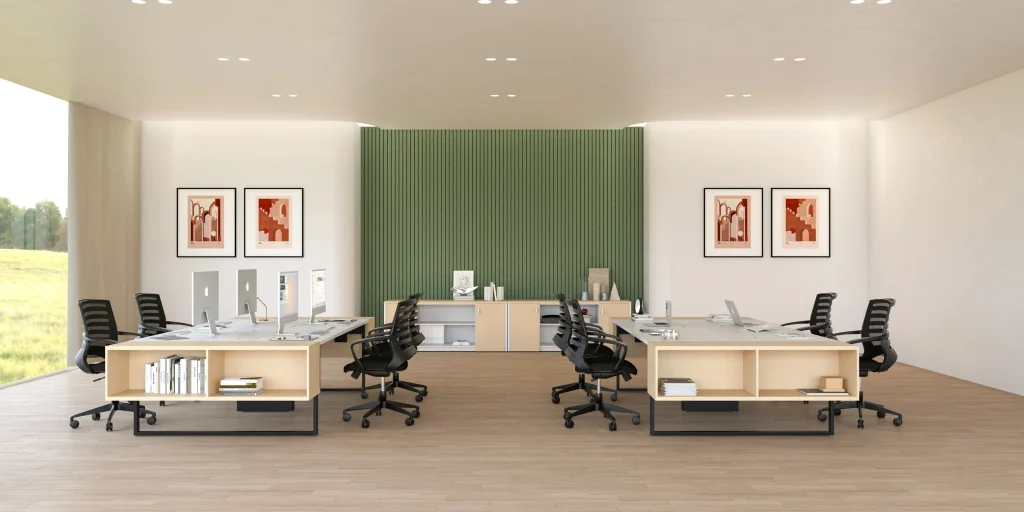
7. Multi-Functional Furniture: One Item, Several Uses
Smart small-office design requires pieces that multitask.
Examples:
- Storage benches
- Height-adjustable tables
- Mobile credenzas
- Stackable and folding chairs
These solutions free up space without sacrificing comfort.
8. Strategic Lighting: A Small Office’s Secret Weapon
Lighting directly affects the perception of space.
Best Practices
- Maximize natural daylighte without sacrificing comfort.
- Indirect LED lighting
- Cooler tones for task work
- Warm light for social zones

9. Lightweight Furniture Profiles: Visual Space Without Sacrifice
Slim silhouettes create openness.
Ideal options:
- Tables with slim metal bases
- Open-frame shelves
- Transparent materials
- Light-colored furniture
10. Declutter by Design: Organization as a Space-Maker
A compact office only works if it stays organized.
Best Practices
- Modular storage systems
- Weekly declutter routines
- Minimalist accessories
- Hidden-tech furniture
Conclusion: Turning Limitations Into Powerful Opportunities
Optimizing a small office isn’t a constraint—it’s an invitation to innovate. With the right strategies, even the most compact corporate spaces can become productive, inspiring, and efficient. At Gebesa, we help organizations, architects, and designers turn every square inch into a competitive advantage. Contact us.
Request a tailored consultation – Explore furniture collections


